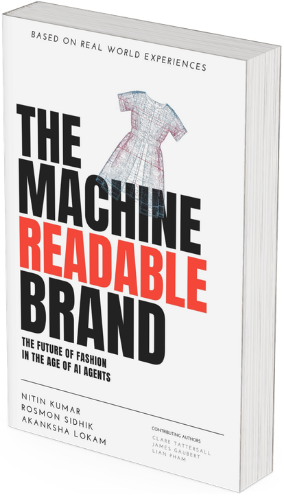
The Machine-Readable Brand, from the team behind The F* Word, is the first operator’s guide to getting found, understood, and recommended by the AI
SAN FRANCISCO, CA, UNITED STATES, July 29, 2026 /EINPresswire.com/ — A shopper opens an AI assistant and asks for a waterproof trench under 300 dollars that ships by Friday. In two seconds the assistant reads dozens of catalogs and returns five options. The brands left out are not beaten in the comparison. They are absent from it, and no dashboard they operate records the loss.
That moment is the subject of The Machine-Readable Brand: The Future of Fashion in the Age of AI Agents, a new book from fashion-technology company The F* Word. The book argues that product discovery has shifted from the search bar to the AI assistant, and that brands a machine can read, rank, and recommend are positioned to gain share as the shift accelerates.
The numbers behind the shift are already large. AI-referred traffic to US retail sites grew 393 percent year over year in early 2026 and converted 42 percent better than any other channel, according to Adobe. Adobe also found that the average retail product page scores 66 percent on machine readability, which leaves roughly a third of published product information difficult for recommending systems to parse. McKinsey has estimated that AI agents could mediate three to five trillion dollars of consumer commerce by 2030. The European Union’s Digital Product Passport begins reaching textiles in 2027, adding a regulatory deadline alongside the commercial one.
“Fashion has always obsessed over how a product looks to a person. The problem now is that a machine sees it first, and most machines cannot read what brands publish. The sale is lost before a human ever looks.” said Nitin Kumar, co-author and founder of The F* Word.
The book reframes seven pressures fashion executives already face, from tariffs to returns to rising acquisition costs, as one underlying problem: the distance between a brand and its own product knowledge. The proposed answer is a single machine-readable product record that the factory builds from, the regulator certifies, and the shopping agent recommends, in place of the scattered PDFs, decks, and images that agents cannot parse.
The book also details how large language models decide what to recommend. According to the authors, models draw on what they already recognize rather than on a brand’s own marketing copy. A pre-registered 2026 study cited in the book found that whether a model already recognized a product predicted recommendations far more strongly than the amount of supporting text, while a brand’s own website copy correlated negatively. Structured data and schema, the book argues, keep a brand legible, while recognition is built over months through the reviews, roundups, and third-party coverage that models absorb.
“Every brand already owns this data. It is just trapped in PDFs and decks no machine can parse. Build the record once, and the factory, the regulator, and the shopping agent can each read what they need.” said Rosmon Sidhik, co-author and Chief Technology Officer of The F* Word.
The book also puts numbers on the cost of the new channel. As marketplaces charge a commission, the authors project that AI platforms will keep a share of each sale they introduce, a figure the book calls the Agent Take Rate, and they argue that this cost belongs in a brand’s margin model before agent-driven volume arrives. The recommended hedge is ownership: converting a customer introduced by an agent into a direct, repeat relationship, measured by what the book terms the Reclaim Rate.
Structured as an operator’s manual, the book runs on fashion’s own units: the sample round, the tech pack, the markdown, the trend window, and the shelf an assistant assembles. It covers product data, merchandising, returns, physical retail, compliance, and the organizational shifts that follow. It introduces original tools including the Agent Shelf, Shelf Share, the Semantic Shelf, the Fit Graph, and the Agent Take Rate, and each chapter closes with a framework, a worked example, and a set of practical steps.
“When anyone can generate a plausible garment, the scarce thing is the judgment that chose this one. That is what a customer pays for, and now it has to be written where a machine can read it.” said Akanksha Lokam, co-author of the book.
The timing reflects two trends the book documents: AI systems are handling longer and more complex tasks each year, and a growing share of shoppers now begin product searches inside assistants rather than search engines. Both move the first moment of discovery into a channel most brands have never measured.
The Machine-Readable Brand is available in paperback and e-book [and audiobook] through Amazon. Sample chapters are available at thefword.ai/machine-readable-brand, which also hosts a four-minute assessment of a brand’s AI readiness. The book is co-authored by Nitin Kumar, Rosmon Sidhik, and Akanksha Lokam, with contributing authors Clare Tattersall, James Gaubert, and Lian Pham.
The full copy of the book can be found at https://a.co/d/053x5csh
Nitin Kumar
The F* Word
+1 408-915-8627
email us here
Visit us on social media:
LinkedIn
Instagram
Legal Disclaimer:
EIN Presswire provides this news content “as is” without warranty of any kind. We do not accept any responsibility or liability
for the accuracy, content, images, videos, licenses, completeness, legality, or reliability of the information contained in this
article. If you have any complaints or copyright issues related to this article, kindly contact the author above.

Media gallery