The Business Research Company’s Industrial Vehicle Global Market Report 2026 – Market Size, Trends, And Forecast 2026-2035
LONDON, GREATER LONDON, UNITED KINGDOM, October 27, 2026 /EINPresswire.com/ — The industrial vehicle market is undergoing rapid transformation, driven by evolving demands in warehousing, electrification, and automation technologies. As companies aim to enhance efficiency and sustainability in logistics and manufacturing operations, competition intensifies among global manufacturers specializing in material handling and industrial mobility solutions. Key priorities revolve around improving productivity, ensuring workplace safety, and meeting stringent regulatory standards.
Industrial Vehicle Market Structure and Competitive Landscape
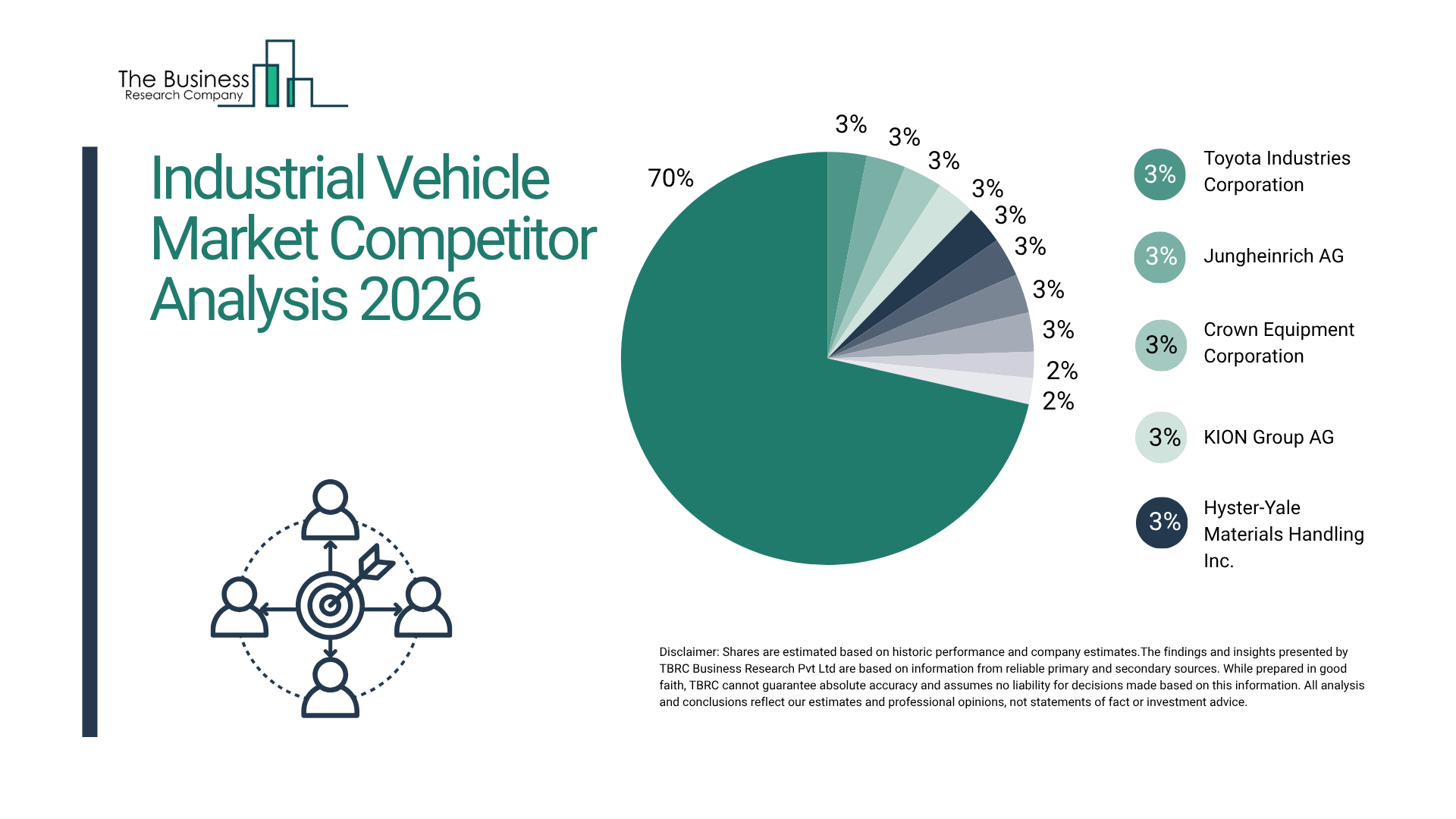
The industrial vehicle market displays moderate fragmentation, with the top ten companies collectively holding about 30% of the total revenue projected for 2025. This market composition indicates that while entry barriers exist—such as advanced engineering, automation integration, and the need for extensive manufacturing and service networks—the sector remains accessible to agile and innovative players. Leading firms maintain their edge by offering diverse vehicle portfolios, fostering strong customer loyalty, and driving continuous advancements in electric mobility, autonomous technology, and intelligent material handling solutions.
Request A Free Sample Of The Industrial Vehicle Market Report
https://thebusinessresearchcompany.com/sample_request?id=12474&type=smp&name=Industrial%20Vehicle%20Market%20Report%202026&utm_source=EINPresswire&utm_medium=Paid&utm_campaign=Oct_PR
Key Players Dominating Industrial Vehicle Market Share
The principal companies expected to command 2025 market revenue include:
• Toyota Industries Corporation – 3%
• Jungheinrich AG – 3%
• Crown Equipment Corporation – 3%
• KION Group AG – 3%
• Hyster-Yale Materials Handling Inc. – 3%
• BYD Company Limited – 3%
• Anhui Heli Co. Ltd. – 3%
• Hangcha Group Co. Ltd. – 3%
• Komatsu Ltd. – 2%
• Caterpillar Inc. – 2%
Innovative Strategies Leading Market Competition
Industry leaders are deploying a variety of cutting-edge technologies to stand out, such as autonomous vehicle systems aimed at streamlining fleet operations. There is also growing incorporation of hydrogen fuel cells to advance zero-emission industrial mobility. Smart telematics are used extensively for real-time equipment monitoring and performance optimization. Additionally, advanced robotics and AI-powered fleet management platforms are revolutionizing warehouse material handling and improving operational efficiency.
Access The Detailed Industrial Vehicle Market Report Here
https://thebusinessresearchcompany.com/report/industrial-vehicle-global-market-report?utm_source=EINPresswire&utm_medium=Paid&utm_campaign=Oct_PR
Toyota Industries Corporation’s Market Leadership
According to data from The Business Research Company, Toyota Industries Corporation secured the top global sales position with a 3% share in 2025. Its industrial vehicle division provides a broad range of products, including forklifts, warehouse equipment, automated guided vehicles, and comprehensive material handling solutions that enhance manufacturing efficiency, logistics workflows, safety standards, and productivity in both industrial and commercial environments.
Key Market Participants Beyond Top Ten
Other notable firms active in the industrial vehicle sector include Doosan Corporation, Kalmar Global, Lonking Holdings Limited, JCB Ltd., Manitou Group, Hyundai Heavy Industries Co. Ltd., SANY Heavy Industry Co. Ltd., Haulotte Group, XCMG Construction Machinery Co. Ltd., Liebherr Group, Kubota Corporation, Sumitomo Heavy Industries Ltd., Merlo S.p.A., Clark Material Handling Company, UniCarriers Corporation, TCM Corporation, and Godrej & Boyce Manufacturing Company Limited.
Projected Market Value of Industrial Vehicles by 2030
The industrial vehicle market is forecasted to exceed $69 billion by 2030. This segment represents roughly 2% of the overall Motor Vehicles market, which is expected to approach $3,972 billion that year. Within the larger Transport industry, projected at $9,400 billion by 2030, industrial vehicles will account for about 1% of the total market value. The anticipated compound annual growth rate (CAGR) up to 2030 is 7%.
Forklifts as the Largest Product Segment in Industrial Vehicles
Among product categories, forklifts dominate the industrial vehicle market, expected to hold 43% of the share in 2030, equating to around $30 billion. This prominence stems from strong demand for efficient material handling within industrial facilities, expansion of warehousing networks, usage in manufacturing and logistics, and a trend toward electric and automated models. Continuous improvements in lifting capability, operator safety, and machine performance further support forklift market growth.
Detailed Segmentation of the Industrial Vehicle Market
The market is divided by drive type into internal combustion engine (ICE), battery-operated, and gas-powered vehicles. It is also segmented by autonomy level, distinguishing between non-autonomous, semi-autonomous, and fully autonomous vehicles. Application-wise, the market covers manufacturing, warehousing, freight and logistics, as well as other specialized uses.
Regional Leadership in Industrial Vehicle Market Growth
The Asia-Pacific region is set to be the largest market by 2030, reaching $26 billion compared to $18 billion in 2025, with a robust CAGR of 8%. This growth is fueled by rapid industrial expansion in China, India, and Southeast Asia, along with significant investments in warehouse automation and logistics infrastructure. Increasing adoption of electric industrial vehicles, rising e-commerce activities, and a strong manufacturing base contribute to the region’s prominence.
Industrial Vehicle Market in the United States
The USA is projected to be the top individual country market for industrial vehicles in 2030, with revenues reaching $16 billion, up from $12 billion in 2025, growing at a 6% CAGR. This rise is supported by the modernization of warehouse and distribution centers, increasing use of automated material handling equipment, demand from manufacturing and freight sectors, investments in smart logistics solutions, and a gradual shift from conventional fleets to energy-efficient alternatives.
Primary Growth Drivers Shaping the Industrial Vehicle Industry
Three main factors are expected to accelerate industrial vehicle market growth up to 2030. First, the surge in e-commerce is boosting warehousing needs, driving demand for forklifts, tow tractors, and automated vehicles that enhance inventory movement and warehouse efficiency. This trend is estimated to contribute about 1.5% annually to market growth.
Environmental regulations also play a critical role by incentivizing electrification of fleets. Stricter emission standards and sustainability goals encourage the transition from fuel-powered to electric vehicles, reducing emissions and operating costs while simplifying regulatory compliance. Supportive government policies, cleaner energy initiatives, and improved battery technologies are expected to add roughly 1.4% annual growth to the market.
Addressing labor shortages with automation is the third crucial factor. Rising labor costs and workforce gaps are fostering investments in autonomous forklifts, robotic transport equipment, and intelligent material handling systems, boosting productivity, accuracy, and safety while reducing dependency on manual labor. This driver is projected to contribute approximately 1.3% yearly growth.
The Impact of Lithium-Ion Technology on Forklifts
Lithium-ion battery-powered forklifts are transforming the industrial vehicle landscape by advancing decarbonization efforts, improving operational efficiency, and enabling electrified material handling in logistics and warehousing environments. For example, in February 2024, KION North America Corporation launched the Linde Series 1293 electric counterbalance forklifts equipped with advanced lithium-ion battery technology. These forklifts, designed for industrial applications with capacities ranging from 4,000 to 5,000 pounds, offer fast-charging capabilities, high-torque electric drives, and ergonomic features that reduce downtime and energy consumption while supporting multi-shift warehouse operations.
Where the Greatest Market Opportunities Lie in Industrial Vehicles
Segments including forklifts, tow tractors, aisle trucks, and container handlers present the most promising growth potential. Collectively, these categories are expected to add over $18 billion in market value by 2030. Forklifts alone are projected to grow by $9 billion, container handlers by $4 billion, aisle trucks by $3 billion, and tow tractors by $2 billion from 2025 to 2030. Key factors driving this expansion include increasing demand for efficient material handling, rapid growth of warehouse and logistics infrastructure, adoption of electric and automated vehicles, and ongoing performance enhancements, reflecting the industrial sector’s focus on productivity, supply chain efficiency, and advanced logistics solutions.
Overview of the Industrial Vehicle Market Supply Chain
The supply chain for industrial vehicles involves major raw material suppliers such as ArcelorMittal, Nippon Steel Corporation, POSCO Holdings, Baosteel Group, thyssenkrupp AG, Nucor Corporation, Rio Tinto, BHP Group, Alcoa Corporation, Norsk Hydro ASA, BASF SE, Covestro AG, SABIC, LyondellBasell Industries, LG Chem, Panasonic Energy Co. Ltd., Samsung SDI, CATL, Umicore, and Glencore.
Wholesalers and distributors play a critical role, including companies like Wajax Corporation, Alta Equipment Group Inc., Equipment Depot, Briggs Equipment, Papé Material Handling, Arnold Machinery Company, Gregory Poole Equipment Company, Eastern Lift Truck Co. Inc., LiftOne LLC, Leavitt Machinery, Fraza, Holt Industrial Rentals, Williams Machinery, Thompson Lift Truck, Morrison Industrial Equipment, Welch Equipment Company, Medley Equipment Company, and Fallsway Equipment Company.
Key end users of industrial vehicles encompass major corporations such as Amazon, Walmart Inc., DHL Group, FedEx Corporation, UPS, Maersk, Toyota Motor Corporation, Volkswagen Group, Ford Motor Company, General Motors Company, Siemens AG, Schneider Electric SE, Procter & Gamble Company, The Coca-Cola Company, Nestlé S.A., Unilever PLC, PepsiCo Inc., Bosch Group, Samsung Electronics, and Foxconn Technology Group.
The 2026 edition of our market reports now delivers enhanced analytical coverage through market attractiveness scoring and analysis, total addressable market (TAM) analysis, company scoring matrix graphics and tables, Excel-based forecasting dashboards, market hotspots infographics, key technologies and future trend analysis, plus updated graphics and tables.
Learn More About The Business Research Company
The Business Research Company (www.thebusinessresearchcompany.com) is a leading market intelligence firm renowned for its expertise in company, market, and consumer research. We have published over 30,000+ reports across 27 industries and 60+ geographies. Our research is powered by 1,500,000 datasets, extensive secondary research, and exclusive insights from interviews with industry leaders.
We provide continuous and custom research services, offering a range of specialized packages tailored to your needs, including Market Entry Research Package, Competitor Tracking Package, Supplier & Distributor Package and much more.
Disclaimer: Please note that the findings, conclusions and recommendations that TBRC Business Research Pvt Ltd delivers are based on information gathered in good faith from both primary and secondary sources, whose accuracy we are not always in a position to guarantee. As such TBRC Business Research Pvt Ltd can accept no liability whatever for actions taken based on any information that may subsequently prove to be incorrect. Analysis and findings included in TBRC reports and presentations are our estimates, opinions and are not intended as statements of fact or investment guidance.
Contact Us:
The Business Research Company
Americas +1 310-496-7795
Europe +44 7882 955267
Asia & Others +44 7882 955267 & +91 8897263534
Email: marketing@tbrc.info
Follow Us On:
LinkedIn: https://in.linkedin.com/company/the-business-research-company“
Oliver Guirdham
The Business Research Company
+44 7882 955267
info@tbrc.info
Visit us on social media:
LinkedIn
Facebook
X
Legal Disclaimer:
EIN Presswire provides this news content “as is” without warranty of any kind. We do not accept any responsibility or liability
for the accuracy, content, images, videos, licenses, completeness, legality, or reliability of the information contained in this
article. If you have any complaints or copyright issues related to this article, kindly contact the author above.

Media gallery