

Qingdao, Shandong, China – November 28, 2026
Global geochemical exploration programmes, mine-site grade-control and third-party mineral-testing laboratories are handling ever-larger bulk drill-core and crushed ore sample lots under ISO/IEC 17025 compliance frameworks. Standard-size laboratory riffle splitters were conceived for small-batch aliquots. When confronted with bulk field-returned samples of tens of kilograms, operational teams are forced to perform repeated sequential splitting cycles, subdividing material in multiple passes. Each manual feeding-and-splitting iteration introduces incremental operating error. Repeated cycles stack these deviations, raising overall subsampling uncertainty before pulverisation and assay work even commence.
Most technical articles about riffle-splitters focus on basic static-gravity splitting principles. This feature article centres on cumulative splitting error induced by multi-pass sample reduction. It analyses the real-world operational bottlenecks that emerge when scaling-up riffle-splitter throughput, explores three intrinsic technical risks for large-volume feed, and defines performance-validation practices that move beyond nominal volume-capacity figures.
Cumulative Error: The Hidden Cost of Repeated Multi-Pass Splitting
Traditional small-capacity riffle-splitters work reliably for sample lots of a few kilograms. For large-mass field-exploration specimens, operators must split, collect one fraction, and re-feed that fraction through the splitter again to achieve the required test-portion mass.
Three distinct error sources compound across successive splitting runs:
Operational feed-bias per pass: Each manual pouring action creates variable material-flow profiles. Particle-size-driven segregation occurs as coarse fragments travel preferentially toward one side of the chute array. Minor imbalance created in one pass propagates into all subsequent subsamples.
Residual cross-contamination risk between repeated cycles: After each split, fine mineral dust adheres to chute surfaces. If incomplete cleaning occurs between iterative runs, leftover material mixes with the next aliquot. In high-throughput environments, frequent partial cleaning amplifies carry-over probability.
Human-procedure variance: Repetitive manual handling introduces inconsistency in pouring height, feed rate and material distribution. Operator fatigue grows with large geochemical-survey sample campaigns, further widening result dispersion across duplicate assays.
In practical terms, even if a single-pass split delivers acceptable representativeness, multi-pass workflows compound these small uncertainties. Large-capacity riffle-splitter hardware addresses this root problem by enabling single-pass reduction of the full bulk lot, eliminating iterative splitting cycles entirely.
Three Intrinsic Technical Challenges for Large-Volume Riffle-Splitter Design
Simply scaling up the physical dimensions of a standard small-capacity riffle-splitter does not guarantee equivalent splitting fidelity. Higher material-flow rates bring three engineering challenges that must be explicitly resolved in hardware design.
1. Flow-driven particle segregation across chute banks
Under high-mass-flow conditions, coarse and dense particles tend to migrate toward flow boundaries. If chute geometry, feed-distribution and inlet transition sections are poorly engineered, coarse fractions disproportionately enter one set of alternating chutes while fine-grained material accumulates in the opposite side. The two resulting subsamples diverge in particle-size and mineral-phase composition, destroying splitting representativeness despite correct riffle-chute width-to-particle-size ratios.
2. Chute bridging and flow blockage under elevated throughput
Increased volumetric throughput raises the probability of particle arching and material bridging inside inclined chutes. This risk intensifies for samples containing significant fine-powder fractions or trace residual moisture. Blockages interrupt continuous workflows; operators must halt processing for manual clearing, breaking SOP continuity for high-volume lab or field-containerised operations.
3. Elevated residual-material retention
Higher total sample mass passing through the unit increases absolute quantity of fine-particle adhesion on internal surfaces. Without optimised internal curvature and high-polish surface finishes, residual build-up accumulates batch-over-batch, increasing cross-sample-carry-over risk even for free-flowing dry ore feedstock.
A well-engineered large-capacity riffle-splitter must resolve all three challenges simultaneously, rather than only increasing hopper-container dimensions.
How Purpose-Built Large-Capacity Static-Gravity Riffle-Splitters Mitigate Scaling-Up Risks
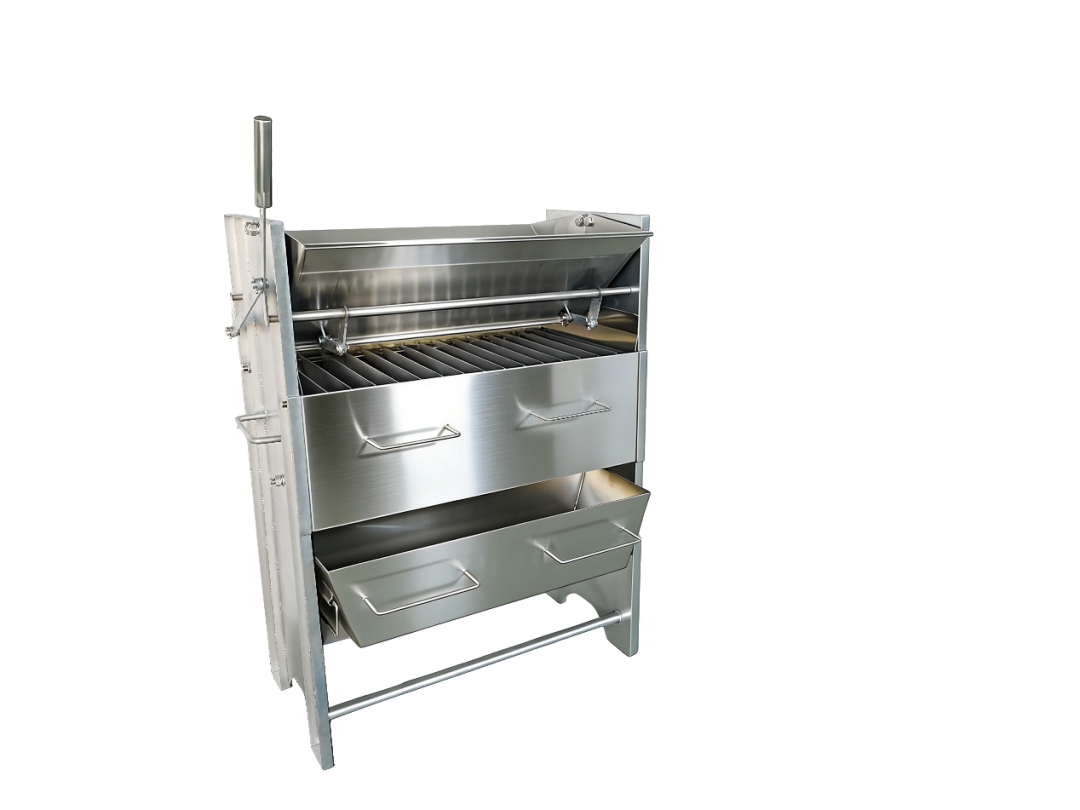
Equipment such as the DRS14-type riffle-splitter adopts linkage-assisted controlled feeding together with optimised chute-hydraulics, while retaining static gravity-driven splitting principle with no rotating internal components. Key design measures target the three scaling-up failure-modes mentioned above.
Controlled linkage-damped feed distribution for single-pass bulk-lot processing A large-volume hopper receives the complete bulk field-sample. Linkage-actuated gates regulate material discharge onto the full width of the riffle-chute bank, avoiding concentrated point-source pouring. Material spreads evenly across all chutes in one single processing cycle. This eliminates the need for iterative re-feeding, and therefore eliminates cumulative multi-pass splitting error.
Flow-optimised chute geometry preventing bridging and blockage Computationally optimised inclined-chute profiles remove sharp internal corners and dead zones. Chute widths maintain adequate margin relative to maximum particle dimension, improving material pass-through for fine-rich or slightly-damp granular mineral specimens. Static gravity-only operation with no motor-driven internals keeps mechanical complexity low for continuous-shift lab and remote-site deployment.
High-grade polished stainless-steel wetted-parts for minimal residue retention All material-contact surfaces utilise smooth polished stainless-steel construction. Combined with semi-open, readily-accessible internal geometry, the design reduces fine-particle adhesion and simplifies complete brushing-and-compressed-air cleaning between dissimilar ore-matrix batches. This keeps cross-contamination risk contained in high-sample-turnaround workflows.
Deployment Context & Clear Operational Boundaries
Within end-to-end mineral-sample-preparation workflows, large-capacity riffle-splitters are situated downstream of primary/secondary crushing and upstream of pulverising equipment. Crushed bulk ore material enters the splitter; two representative subsamples are produced in one pass: one for archival retention, the second proceeding to fine grinding and assay. This workflow suits mine-QC labs, commercial-contract-testing houses and container-style mobile field-preparation labs for exploration projects.
Non-negotiable operational limits still apply: – Performance assumes free-flowing granular material. Highly-clay-rich, heavily-moist, cohesive ore will adhere to chute surfaces, disrupt flow patterns and degrade splitting quality. Such feedstock requires pre-drying pre-treatment. – Even with optimised hardware, splitting operations must still respect Gy-based minimum-sample-mass requirements matched to maximum particle size; larger-capacity hardware does not override fundamental sampling-theory constraints.
Practical Performance-Evaluation Framework Beyond Stated Volume Specifications
When assessing large-capacity riffle-splitter hardware, purchasing teams should not base decisions solely on published hopper-volume figures. Three sets of hands-on validation tests uncover real-world performance:
Full-lot single-pass representativeness test: Feed representative bulk reference ore at rated maximum capacity. Collect both output subsamples. Carry-out elemental assay and particle-size-distribution comparison. Quantify grade divergence between the two splits to expose flow-induced segregation under full-throughput conditions.
Throughput and anti-blockage assessment: Run repeated full-capacity cycles with project-typical fine-bearing ore, documenting occurrence of bridging or chute blockage. Evaluate speed and thoroughness of access-and-cleaning procedures post-run.
System-compatibility audit: Confirm physical footprint, inlet/outlet elevation and feeding-gate mechanics allow integration with existing crushing-to-pulverising sample-preparation lines, including compact container-lab spatial constraints.
Key take-away: Large nominal capacity is merely a physical dimension. Real value comes from maintaining splitting representativeness when operating at that full rated capacity, while removing multi-pass cumulative-error sources.
DRS14 large-capacity riffle splitter manufactured by Qingdao Decent Group implements linkage-controlled uniform feeding, optimised chute geometry and all-stainless-steel wetted components. Built for single-pass processing of high-volume crushed mineral lots, it serves central mineral-testing labs as well as remote containerised field-sample-preparation installations globally.
Full technical resource: https://www.decent-group.com/product/drs14-riffle-splitter/
Growing-scale global mineral-exploration projects generate ever-larger bulk drill-core and crushed ore samples. Many laboratories address higher sample volumes by repeating splitting cycles on conventional small-capacity riffle-splitters, unaware of cumulative splitting-error building across successive passes.
Large-capacity riffle-splitter technology should not be judged only by how much sample the hopper can physically contain. Its core engineering purpose is to enable representative single-pass reduction of complete bulk lots, eliminating iterative multi-pass workflows and their compounded sampling uncertainty. Hardware must resolve flow-driven segregation, chute-bridging risk and residual-material retention if high-volume capacity is to translate into reliable subsample integrity.
Even well-optimised large-capacity riffle-splitters operate within material-property boundaries. Equipment selection must align with actual sample-matrix characteristics, while evaluation work should rely on practical full-load performance trials rather than datasheet-only specifications.
About Us
Qingdao Decent Group is a global high-tech enterprise specializing in innovative mineral laboratory equipment and systems. With strong R&D, advanced manufacturing, and worldwide service capabilities, DECENT delivers efficient, precise, and sustainable laboratory solutions, including fire assay equipment, sample-preparation systems, and containerized mobile labs.
Media Contact
Company Name: Qingdao Decent Electromechanical Tech Co., Ltd.
Contact Person: Media Relations
Email: Send Email
Country: China
Website: https://www.decent-group.com
Press Release Distributed by ABNewswire.com
To view the original version on ABNewswire visit: Cumulative-Splitting-Error Risk: Engineering Large-Capacity Static Riffle Splitters for High-Volume Mineral Exploration Sample-Preparation