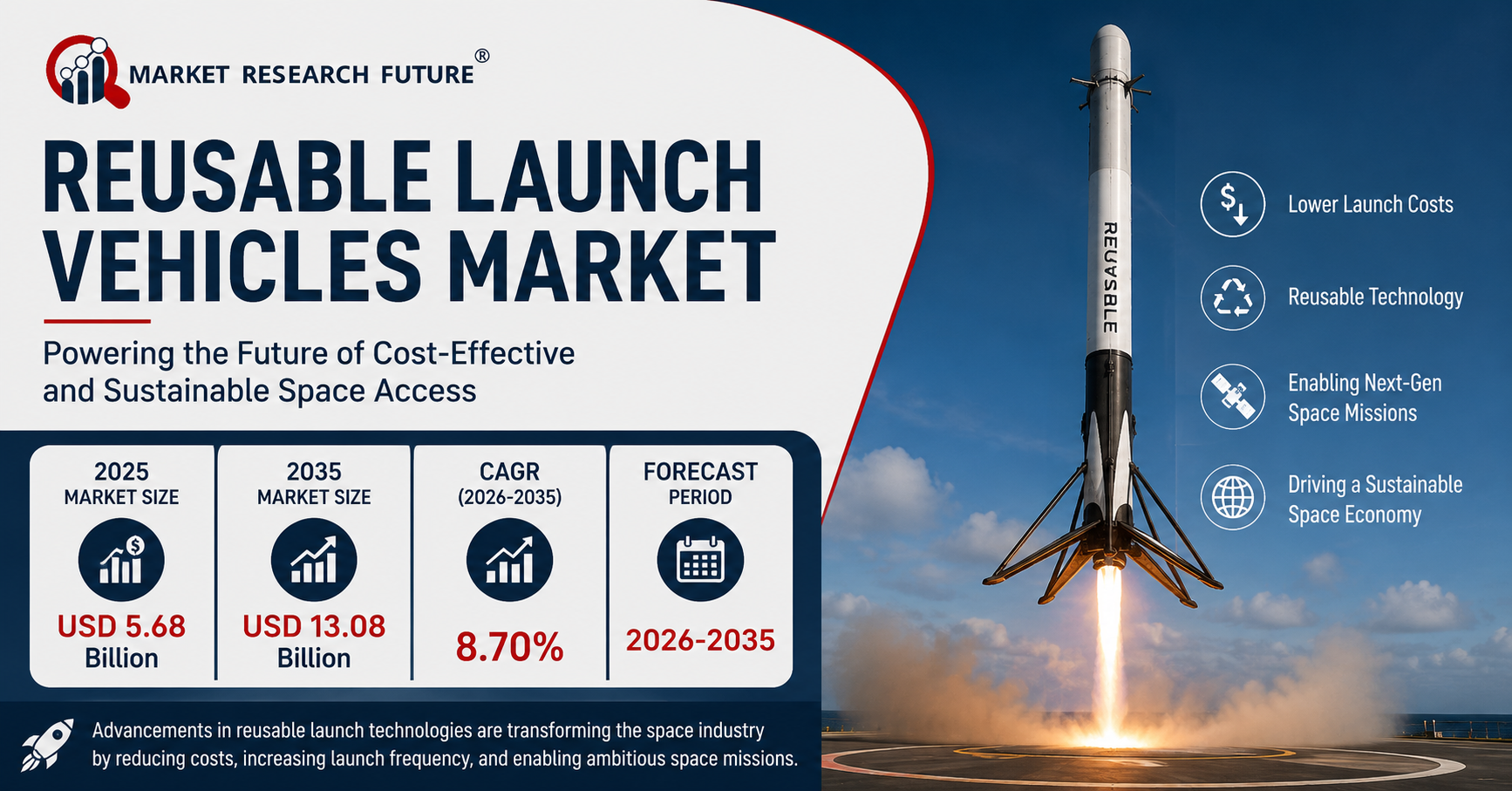
NEW YORK, NY, UNITED STATES, June 23, 2026 /EINPresswire.com/ — The Reusable Launch Vehicles (RLV) Market is undergoing a transformative phase driven by rapid advancements in rocket reusability, cost optimization in space missions, and increasing demand for frequent satellite deployment. According to industry projections, the market is expected to grow from USD 5.68 billion in 2025 to USD 13.08 billion by 2035, expanding at a CAGR of 8.70% during 2026–2035. This growth reflects a fundamental shift in the aerospace industry toward sustainable and economically viable launch systems, enabling both government and commercial space missions to scale efficiently.
Reusable launch systems are redefining the economics of space exploration by significantly reducing per-launch costs, improving turnaround times, and enhancing mission flexibility. As space becomes more commercialized, the demand for reusable technologies is accelerating across satellite deployment, deep-space missions, defense applications, and human spaceflight programs.
Market Overview and Evolution:
The reusable launch vehicles market represents a paradigm shift from traditional expendable launch systems to reusable architectures that allow rocket stages—particularly boosters—to be recovered, refurbished, and relaunched multiple times. This innovation has been pioneered and rapidly commercialized over the past decade, leading to a competitive ecosystem of private aerospace firms and government agencies investing heavily in reusable technologies.
Key industry drivers include:
Rising satellite constellation deployments for broadband connectivity
Increasing frequency of space missions
Cost pressure on launch services
Technological advancements in vertical landing systems
Government privatization of space programs
The market is now transitioning from early-stage validation to large-scale operational deployment.
Request Sample PDF of Report: https://www.marketresearchfuture.com/sample_request/24980
Latest Trends in the Reusable Launch Vehicles Market:
1. Expansion of Fully Reusable Launch Systems
The industry is shifting beyond partially reusable rockets toward fully reusable systems, where both boosters and upper stages are recoverable. This trend is expected to redefine launch economics by enabling airline-like turnaround cycles.
2. Autonomous Landing and AI-Based Navigation
Advanced AI-driven guidance systems are increasingly being integrated into launch vehicles to improve landing precision and reduce human intervention. These systems enhance booster recovery success rates and mission reliability.
3. Rise of Commercial Mega-Constellations
The rapid deployment of satellite networks for broadband internet and Earth observation is driving high launch frequency, increasing reliance on reusable systems for cost efficiency.
4. Green Propulsion Technologies
Sustainable rocket fuels and eco-friendly propulsion systems are gaining traction to reduce environmental impact and align with global sustainability goals.
5. Modular and Rapid Reusability Designs
Next-generation launch vehicles are being designed with modular architectures enabling faster refurbishment cycles and higher launch cadence.
Market Drivers:
1. Declining Cost of Access to Space – Reusable launch vehicles drastically reduce per-launch costs by recovering major components such as boosters. This cost efficiency is a key factor accelerating adoption across commercial and defense sectors.
2. Growth in Satellite-Based Services – The demand for communication, navigation, and Earth observation satellites is surging, requiring frequent and reliable launch capabilities.
3. Government and Defense Investments – Space agencies and defense organizations are increasingly investing in reusable technologies to improve mission readiness and strategic capabilities.
4. Commercialization of Space Exploration – Private companies are playing a dominant role in expanding space activities, fueling innovation in reusable systems.
5. Technological Advancements in Rocket Engineering – Improvements in propulsion systems, materials science, and avionics are enabling safer and more efficient reusable designs.
Market Opportunities:
1. Expansion of LEO Satellite Constellations – Low Earth Orbit (LEO) satellite networks present a massive opportunity for reusable launch providers due to high-frequency launch requirements.
2. Deep Space and Interplanetary Missions – Reusable systems reduce mission costs, enabling more frequent exploratory missions to the Moon, Mars, and beyond.
3. Commercial Space Tourism – Emerging space tourism initiatives will rely heavily on reusable vehicles to make suborbital and orbital travel economically viable.
4. Defense Space Programs – Military applications, including surveillance and secure communications, are expected to increasingly adopt reusable launch platforms.
5. Emerging Market Participation – Countries investing in domestic space programs present significant opportunities for global aerospace companies.
Segment Analysis:
1. By Type
Partially Reusable – Partially reusable systems dominate current operations, where boosters are recovered and reused while upper stages are expendable. This segment remains the most commercially viable due to lower development complexity and proven reliability.
Fully Reusable – Fully reusable launch vehicles represent the future of space transportation. These systems aim to recover and reuse all major components, significantly reducing operational costs and enabling rapid launch cycles.
2. By Configuration
Two-Stage-to-Orbit (TSTO) – TSTO systems are the most widely used configuration, offering a balance between performance and reusability. They allow efficient payload delivery while maintaining recovery capability for first-stage boosters.
Single-Stage-to-Orbit (SSTO) – SSTO systems remain technologically challenging but hold long-term potential due to their simplified architecture and full reusability potential.
3. By Payload Class
Small Payload – Small payload launches are increasingly driven by CubeSats and small satellite constellations, requiring frequent and cost-efficient launch solutions.
Medium Payload – This segment supports commercial communication satellites and Earth observation systems, forming a major revenue contributor.
Heavy Payload – Heavy payload launches are critical for deep space missions, space stations, and large satellite deployments, requiring advanced reusable heavy-lift rockets.
4. By End User
Commercial – The commercial segment dominates the market, driven by private satellite operators, broadband providers, and space technology companies.
Defense & Government – Government and defense agencies continue to invest heavily in reusable launch systems for strategic and scientific missions.
5. By Mission
Satellite Deployment – The largest application segment, driven by increasing global connectivity requirements and Earth observation needs.
Human Spaceflight – Reusable vehicles play a crucial role in reducing costs for crewed missions and enabling long-term space habitation projects.
Cargo Resupply & Other Missions – Includes International Space Station resupply missions and experimental payload deployments.
Regional Analysis;
North America – North America leads the global reusable launch vehicles market due to strong presence of major aerospace companies, advanced R&D capabilities, and high government funding. The region is the hub of innovation in reusable rocket technologies.
Europe – Europe is steadily advancing its reusable launch capabilities through collaborative efforts among aerospace organizations and government agencies. Focus is placed on achieving independence in space launch services.
Asia-Pacific – Asia-Pacific is expected to witness the fastest growth, driven by increasing space investments from countries such as India, China, and Japan. Expanding satellite programs and national space missions are boosting demand.
Middle East & Africa – The region is gradually investing in space technologies, with growing interest in satellite communications and scientific research missions.
Latin America – Latin America is emerging in the space sector, focusing on satellite deployment for communication, agriculture, and disaster management.
Top Companies Profiled:
SpaceX – SpaceX is the global leader in reusable rocket technology, pioneering vertical landing systems and achieving high-frequency booster reuse. Its Falcon 9 and Starship programs have redefined commercial space launch economics.
Rocket Lab – Rocket Lab focuses on small satellite launch services with partially reusable systems, including booster recovery innovations for its Electron rocket.
Blue Origin – Blue Origin is advancing reusable launch systems through its New Glenn rocket program, emphasizing fully reusable architecture and orbital-class recovery systems.
ArianeGroup – ArianeGroup is developing next-generation European reusable launch solutions aimed at improving competitiveness in global launch markets.
United Launch Alliance (ULA) – ULA is transitioning toward partial reusability with its Vulcan Centaur rocket, integrating cost-efficient recovery technologies.
China Aerospace Science and Technology Corporation (CASC) – CASC is actively developing reusable rocket technologies as part of China’s long-term space exploration strategy.
Northrop Grumman – Northrop Grumman focuses on hybrid reusable systems and support services for government and defense launch programs.
Relativity Space – Relativity Space is innovating with 3D-printed reusable rockets, aiming to simplify manufacturing and improve reusability.
ISRO – The Indian Space Research Organisation (ISRO) is advancing reusable launch vehicle technology to enhance cost-effective access to space.
Mitsubishi Heavy Industries (MHI) -MHI contributes to Japan’s space programs with reusable launch research and next-generation rocket development initiatives.
Recent Developments:
March 2025 – SpaceX: Achieved the 400th successful Falcon 9 booster landing, demonstrating the operational maturity and scalability of reusable vertical landing systems. This milestone reinforces SpaceX’s dominance in reusable rocket operations and sets a global benchmark for launch reliability.
January 2025 – Blue Origin: Successfully completed the inaugural orbital mission of the New Glenn rocket from Cape Canaveral, marking a major breakthrough in full-scale reusable launch systems. The mission included successful recovery of the first-stage booster, validating its reusable design architecture.
Conclusion:
The Reusable Launch Vehicles Market is entering a high-growth era driven by commercialization of space, technological breakthroughs, and increasing global demand for frequent and cost-effective launch solutions. With a projected valuation of USD 13.08 billion by 2035, the market is expected to evolve into a cornerstone of the modern aerospace economy.
As companies continue to refine reusable technologies and expand mission capabilities, the industry will witness faster launch cycles, reduced costs, and broader access to space across commercial, defense, and scientific domains.
Browse More Reports:
Reusable Satellite Launch Vehicle Market
https://www.marketresearchfuture.com/reports/reusable-satellite-launch-vehicle-market-6157
Satellite Launch Vehicle (SLV) Market
https://www.marketresearchfuture.com/reports/satellite-launch-vehicle-market-8759
Infantry Fighting Vehicle Market
https://www.marketresearchfuture.com/reports/infantry-fighting-vehicle-market-7392
Sagar Kadam
Market Research Future
+1 628-258-0071
sales@marketresearchfuture.com
Visit us on social media:
LinkedIn
Facebook
X
Legal Disclaimer:
EIN Presswire provides this news content “as is” without warranty of any kind. We do not accept any responsibility or liability
for the accuracy, content, images, videos, licenses, completeness, legality, or reliability of the information contained in this
article. If you have any complaints or copyright issues related to this article, kindly contact the author above.

Media gallery