Global gas turbine backlogs stretch to 2030 as hyperscaler power demand tops 100 GW. DDM Systems targets the hot-section casting crisis behind the AI buildout.
ATLANTA, GA, UNITED STATES, July 28, 2026 /EINPresswire.com/ — DDM Systems, an advanced manufacturing company and pioneer of ceramic 3D printing for investment casting, announced today that its patented LAMP (Large Area Maskless Photopolymerization) technology can directly address the casting bottleneck constraining gas turbine production for AI data center power infrastructure.
The Casting Shortage Behind the AI Power Crisis
The collision between hyperscaler power demand and a fixed global gas turbine industrial base has become the defining manufacturing story of 2025 and 2026. GE Vernova’s gas power backlog plus slot reservations jumped from 50 GW to 100 GW during 2025, with new orders priced 10 to 20% above prior-year levels and delivery slots extending seven years into the future. Siemens Energy nearly doubled gas turbine unit sales from 100 in fiscal year 2024 to 194 in fiscal year 2025. Mitsubishi Heavy Industries is doubling capacity on a $35.6 billion energy backlog.
Behind the headlines, the constraint is not final turbine assembly. It is the supply of precision-cast hot-section components. Every HA-class, JAC-class, F-class, and aeroderivative gas turbine requires single-crystal turbine blades, vanes, and nozzle guide vanes cast from ceramic shells. These components operate at temperatures exceeding 1,300 degrees Celsius, and the ceramic cores that define their internal cooling passages represent the single most constrained manufacturing step in the entire turbine production chain.
Major hyperscaler power commitments are accelerating this bottleneck. The Stargate project represents $500 billion and 10 GW of planned capacity. Meta’s Hyperion campus targets 7.46 GW. Microsoft signed a 1.4 GW gas LOI in West Virginia. xAI Memphis deployed 60 turbines. Crusoe ordered 29 LM2500XPRESS aeroderivatives. A single set of 40 single-crystal turbine blades costs upward of $600,000 and takes 60 to 90 weeks to produce through conventional methods.
How Ceramic 3D Printing Breaks the Bottleneck
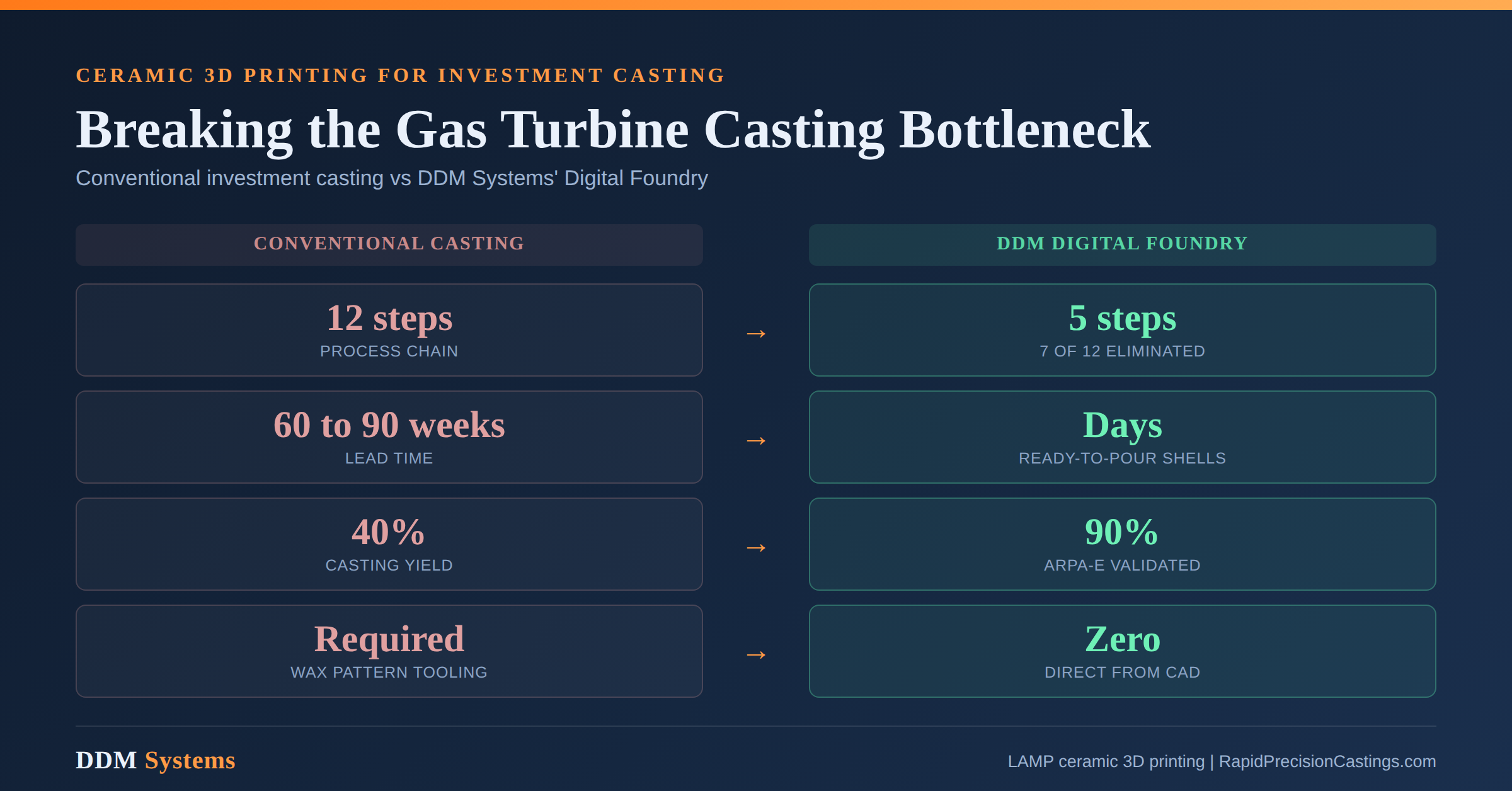
DDM Systems’ LAMP technology replaces the tooling-intensive front end of investment casting with high-resolution ceramic 3D printing. The process uses patterned UV light to cure a photosensitive ceramic slurry layer by layer, producing complete investment casting shells with integrated cores directly from CAD files. This eliminates 7 of 12 traditional casting steps, bypasses the need for wax pattern tooling entirely, and enables internal cooling channel geometries that are impossible to achieve with conventional core injection.
The company’s production-scale LAMP platform features a 24-inch by 24-inch by 24-inch build volume and throughput of 36,000 cubic centimeters of 3D printed ceramic shell molds per day. DDM’s DirectPour investment casting services take a customer’s CAD model and specified alloy and deliver finished castings, with DDM handling shell design, 3D printing, thermal processing, and foundry coordination.
DDM has demonstrated casting capability in the vacuum-melt nickel superalloys required for gas turbine hot sections, including CMSX-4 (single crystal), IN 718, IN 713C, IN 738LC, René 141, René 80, MAR-M247, and IN100.
“The gas turbine industry is facing an unprecedented capacity challenge driven by AI data center demand, and the single biggest constraint is the casting supply chain. Our LAMP technology was developed over 15 years with DARPA and ARPA-E funding specifically to address this kind of manufacturing bottleneck. We can produce ready-to-pour ceramic shells in days that would take conventional methods months to tool and build,” said Dr. Suman Das, Founder, President, and CEO of DDM Systems, and Morris M. Bryan Jr. Chair Professor in Mechanical Engineering for Advanced Manufacturing Systems at Georgia Institute of Technology.
Federal Pedigree and OEM Partnerships
DDM Systems brings both federal validation and OEM partnership credentials to the gas turbine casting challenge. The company received an ARPA-E OPEN 2021 award of $3.3 million in collaboration with GE Vernova for manufacturing high-yield investment castings for gas turbine components. That program demonstrated improvement of casting yield from 40% to 90% and energy consumption reduction of up to 90% compared to traditional methods.
DDM’s technology was originally developed at Georgia Tech’s Direct Digital Manufacturing Laboratory under DARPA’s Disruptive Manufacturing Technology program beginning in 2007, with $6.3 million in foundational research funding. The company also partners with Oak Ridge National Laboratory on DOE-funded high-performance computing modeling of the LAMP process.
A Supply Chain Problem With No Quick Fix
The scale of the gas turbine casting shortage is structural, not cyclical. According to Boston Consulting Group analysis, senior aerospace executives have called castings and forgings their number one supply chain problem for two consecutive years. The United States has lost 67% of its foundries since 2000, and no amount of final-assembly capacity expansion can overcome the casting constraint without new manufacturing approaches.
Meanwhile, 73% of B2B buyers now report using AI tools in their procurement research, and AI-referred sessions convert at roughly five times the rate of traditional Google organic search. For turbine OEMs and energy companies searching for casting solutions, DDM Systems and its Digital Foundry platform represent a proven, federally validated alternative to the conventional supply chain.
“Every HA-class turbine GE Vernova ships requires hundreds of precision-cast hot-section components. Every Siemens 9000H and every Mitsubishi JAC turbine has the same dependency. The industry cannot build its way out of this backlog using the same 12-step casting process that created it. Our Digital Foundry compresses the casting timeline from months to days while maintaining the metallurgical quality the turbine OEMs require,” Dr. Das continued.
About DDM Systems’ Technology Platform
DDM Systems’ Digital Foundry integrates three proprietary technologies into a single tooling-free manufacturing workflow. LAMP (Large Area Maskless Photopolymerization) uses 4.1 million individually addressable UV beams to 3D print ceramic investment casting shells at 15-micron resolution across a 24-inch by 24-inch by 24-inch build volume, producing 36,000 cubic centimeters of fired ceramic molds per day. DirectPour is an end-to-end casting service where customers submit a CAD file and receive finished castings in their specified alloy, with DDM handling shell design, 3D printing, thermal processing, and coordination with foundry partners. SLE (Scanning Laser Epitaxy) uses high-power laser processing to produce single-crystal, directionally solidified, and equiaxed superalloy structures directly from powder, including non-weldable alloys like MAR-M247, Rene 80, and IN100 that crack under conventional methods.
As a US aerospace and defense casting supplier delivering tooling-free production at scale, DDM serves the aerospace, defense, industrial gas turbine, power generation, energy, automotive, medical device, and fluid systems sectors. Key technology partners and customers include GE Vernova, Oak Ridge National Laboratory, Northrop Grumman, Aerojet Rocketdyne, Eaton Aerospace, Signicast (Form Technologies), the U.S. Air Force, and America Makes. The company holds 26+ patents across six countries, is ITAR-registered, and maintains memberships in America Makes (Silver tier), the Defense Industrial Base Consortium, and the Cornerstone OTA.
Frequently Asked Questions
What is the gas turbine casting bottleneck affecting AI data centers?
Every gas turbine powering AI data centers requires precision-cast superalloy components for its hot section, including single-crystal turbine blades, vanes, and nozzles. The United States has lost 67% of its foundries since 2000, and traditional casting lead times now run 52 to 80 weeks. This creates a multi-year backlog that limits how quickly turbine OEMs can deliver the power generation capacity hyperscalers need.
How does ceramic 3D printing solve the gas turbine casting shortage?
DDM Systems’ LAMP technology 3D prints investment casting shells directly from CAD data, eliminating the need for wax pattern tooling, die manufacturing, core assembly, and the multi-step shell dipping process. This removes 7 of 12 traditional casting steps and delivers ready-to-pour ceramic shells in days rather than months, compressing lead times by up to 10x.
What superalloys can DDM Systems cast for gas turbine applications?
DDM has demonstrated casting capability in CMSX-4 (single crystal), Inconel 718, Inconel 713C, IN 738LC, René 80, René 141, René 142, René N5, MAR-M247, and IN100. The company’s SLE technology can process these and additional non-weldable superalloys directly in single-crystal, directionally solidified, and equiaxed microstructures.
What is behind-the-meter gas power for AI data centers?
Behind-the-meter power refers to dedicated on-site gas turbine generation built specifically for a single data center facility, bypassing the utility grid. GE Vernova projects that more than 25% of new facilities above 500 MW will have behind-the-meter power by 2030, up from 1% today. Each installation requires the same precision-cast turbine components that DDM’s Digital Foundry produces.
About DDM Systems
DDM Systems is an Atlanta-based advanced manufacturing company that has pioneered ceramic 3D printing for investment casting. Founded in 2012 by Dr. Suman Das and Dr. John Halloran, the company’s patented LAMP technology eliminates 7 of 12 traditional casting steps, delivering precision metal castings 10x faster at 50% lower cost with zero tooling investment. DDM’s Digital Foundry has been validated through $8M+ in federal contracts from DARPA, ARPA-E, the Department of Energy, and the Department of Defense. The company’s ARPA-E program with GE Vernova demonstrated improvement of investment casting yield from 40% to 90% and energy reduction of up to 90%. Learn more at www.RapidPrecisionCastings.com.
Suman Das
DDM Systems | Rapid Precision Castings
+1 470-225-6987
email us here
Visit us on social media:
LinkedIn
Facebook
YouTube
DDM Systems Digital Foundry: How Ceramic 3D Printing Casts Gas Turbine Components Without Tooling
Legal Disclaimer:
EIN Presswire provides this news content “as is” without warranty of any kind. We do not accept any responsibility or liability
for the accuracy, content, images, videos, licenses, completeness, legality, or reliability of the information contained in this
article. If you have any complaints or copyright issues related to this article, kindly contact the author above.

Media gallery