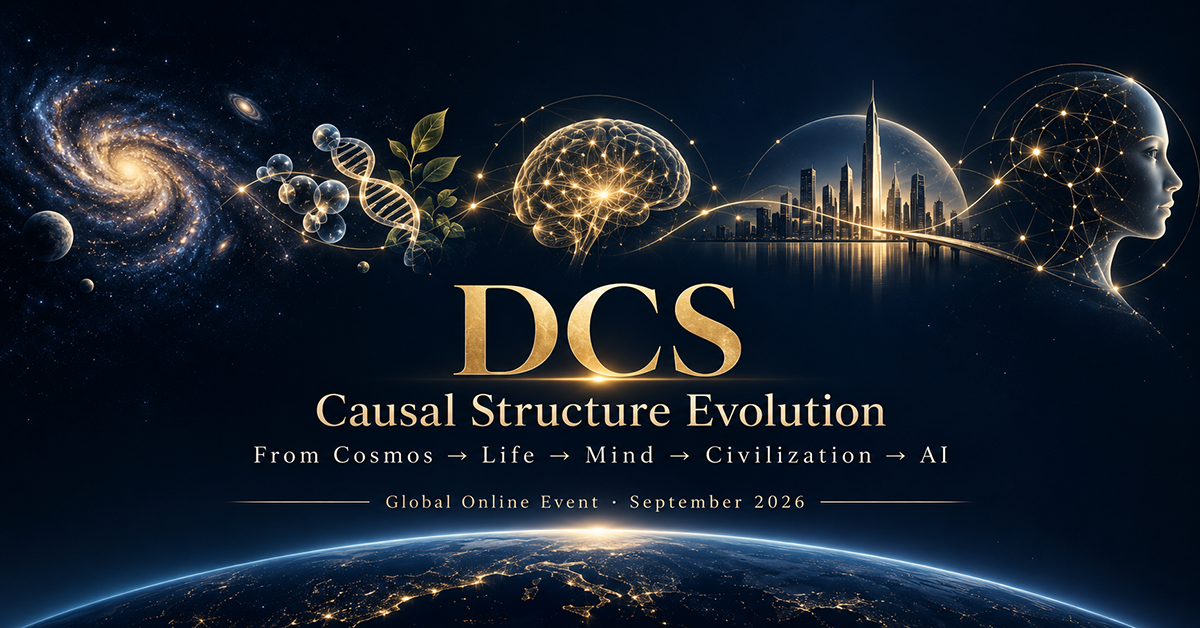
AI-assisted research program examines recurring causal transitions across physics, life, mind, civilization and artificial intelligence.
SHENZHEN, CHINA, September 16, 2026 /EINPresswire.com/ — MINDAS.ME is introducing DCS, a cross-scale causal evolution framework that examines how new levels of organization may emerge across approximately 13.8 billion years—from physical structure and life to mind, civilization and artificial intelligence.
DCS begins with a simple question: how did a universe without life, brains or AI eventually produce systems capable of memory, prediction, planning and deliberate intervention in the world? Rather than replacing the sciences that study each stage, the project asks whether some recurring causal transitions can be compared across them.
The framework focuses on a proposed sequence in which possibilities are constrained by dynamics, some structures persist, some lower-level interactions become partially encapsulated or compressed into higher-level variables, and new macro-level variables may acquire predictive or causal relevance. In simplified form, DCS studies a progression from causal structure and persistence to causal compression, causal emergence, causal prediction and causal intervention.
DCS also distinguishes between pre-biological structural evolution and Darwinian biological evolution. Before life, the relevant processes concern the formation, stability and transformation of physical structures. Once heredity, variation and differential reproduction emerge, selection can act on systems capable of generating and transmitting structure across generations.
The project extends this comparison to brains, civilization and AI. Neural systems can use information from the past to anticipate future states and guide action. Human societies extend memory, coordination and causal influence through language, writing, institutions and technology. AI systems increasingly combine prediction with memory, tools, software and real-world interfaces, raising a further question: when does greater predictive ability become greater causal reach?
Artificial intelligence is not only a subject of DCS but also part of its research workflow. Large language models and AI agents are used for literature discovery, cross-disciplinary comparison, counterargument generation, fact-checking, knowledge organization and iterative review. The project treats DCS as a living framework whose claims should be revised as new evidence, criticism and formal analysis become available.
The work is led by Rongjie Wei through a one-person company (OPC) research model supported by AI tools. That structure creates a second experiment alongside the theory itself: whether AI can give an individual access to parts of the search, synthesis, critique and knowledge-management functions that previously required larger interdisciplinary teams.
“The goal of DCS is not to declare a final theory, but to build an open causal framework that can be challenged, formalized, computed and tested,” said Rongjie Wei, founder and CEO of Shenzhen Ruier Maisi Technology Co., Ltd. “AI can expand the scale of questions one person can explore, but scientific value still depends on evidence, mathematics, criticism and falsifiability.”
DCS is therefore being presented as a developing research framework rather than an established unified theory. Its next stage focuses on operational definitions, mathematical formulation, computational models, links to existing scientific literature, and tests that could distinguish its claims from alternative explanations.
The September 16, 2026 global online event, “Finding the First Principles of Evolution,” marks the formal public introduction of DCS as an open, developing research framework for criticism, formalization and testing. The event connects DCS’s scientific questions with a broader issue facing the AI era: how expanding human and machine capacities for prediction and intervention may affect future forms of social and technological organization.
Additional DCS research materials, including a public preprint with DOI 10.5281/zenodo.22709952, along with event information and project updates, are available through MINDAS.ME at [https://mindas.me/](https://mindas.me/).
About Shenzhen Ruier Maisi Technology Co., Ltd.
Shenzhen Ruier Maisi Technology Co., Ltd. is a Shenzhen-based technology company developing AI-native projects and research initiatives related to human cognition, intelligent systems and emerging forms of human-AI collaboration. MINDAS.ME serves as a public platform for related research, ideas and projects.
Rongjie Wei
Shenzhen Ruier Maisi Technology Co., Ltd.
+86 188 2656 2299
contact@mindas.me
Visit us on social media:
LinkedIn
Instagram
Facebook
YouTube
TikTok
X
Other
Legal Disclaimer:
EIN Presswire provides this news content “as is” without warranty of any kind. We do not accept any responsibility or liability
for the accuracy, content, images, videos, licenses, completeness, legality, or reliability of the information contained in this
article. If you have any complaints or copyright issues related to this article, kindly contact the author above.

Media gallery